
Dexcom G6 vs. Dexcom G7: Which Continuous Glucose Monitor is Right for You?
According to the National Diabetes Statistics Report 2023 by the Centers for Disease Control and Prevention (CDC), 38.4 million people in the US have diabetes, which is 11.6% of the adult population. However, 97.6 million people over 18 years have prediabetes condition, and this forms 38% of the adult population. The report also states that diabetes prevalence has increased significantly among adults between 2001 and 2021. As a result, there is an increasing awareness about managing diabetes by making lifestyle changes, taking medications, and so on.
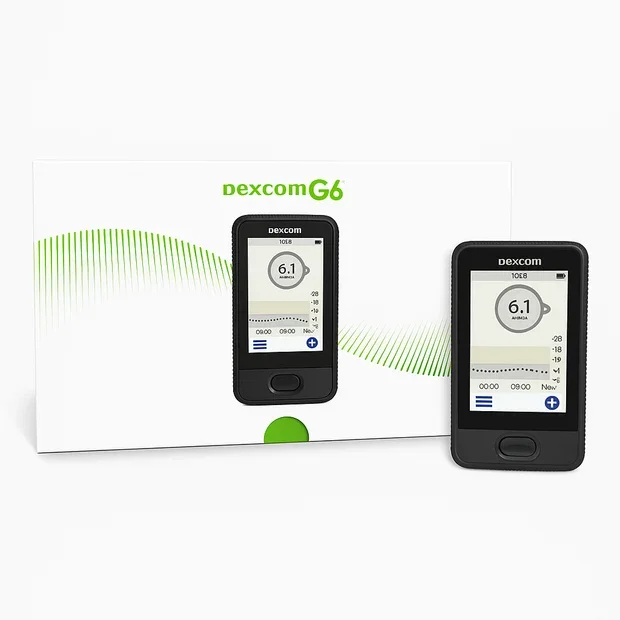
Continuous glucose monitoring (CGM) is one of the important aspects of diabetes management. This can be achieved easily using Dexcom Continuous Glucose Monitoring (CGM). Designed and offered by Dexcom, these systems are designed to integrate with your lifestyle seamlessly and they help users manage their Type 1 and Type 2 diabetes with confidence. Dexcom G6 and G7 are two CGM systems offered by Dexcom to support people with Type 1 diabetes to manage their diabetes effectively. Having said so, how do these systems differ? Which is the right system for your diabetes monitoring needs? If that sounds familiar, read the post to know the answers.
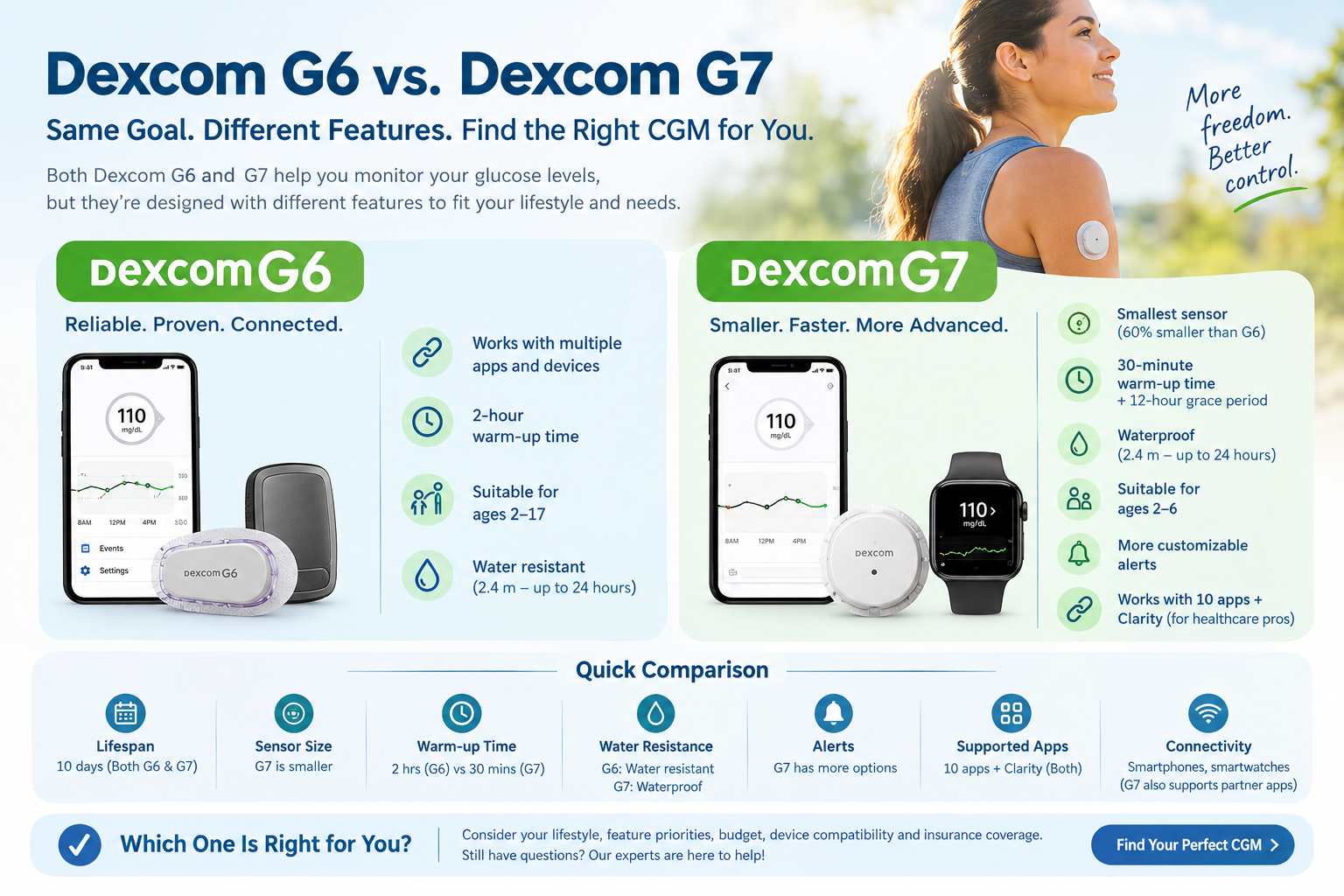
Overview of Dexcom G6 and Dexcom G7 CGM
Dexcom G6
• According to the official Dexcom website, Dexcom G6 CGM is the first integrated CGM system in the world that is designed to be compatible with a host of digital health apps, such as Nudg and Glooko as well as Tandem t-slim X2, CamAPS FX, YpsoPump, and so on.
• This sensor has a 2-hour warm-up period, which would require patience and diligence on your part.
• Dexcom G6 is suited for 2–17-year-olds and it offers more placement options for teenagers and children.
Dexcom G7
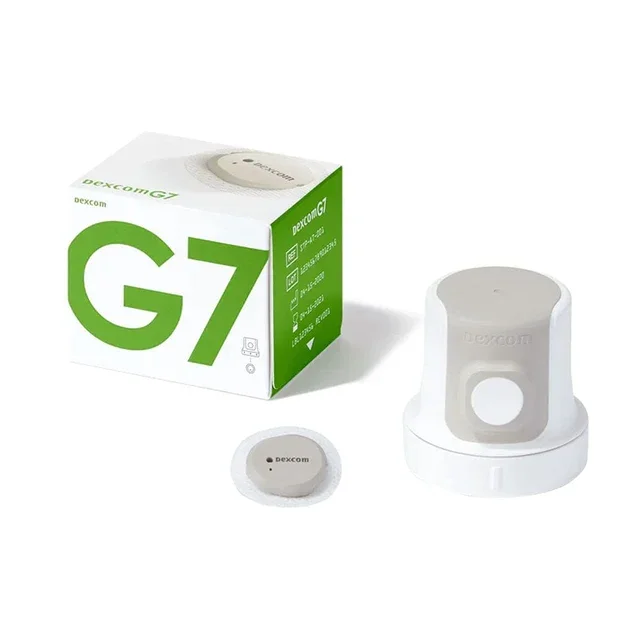
• Dexcom G7 CGM is the most powerful and the smallest CGM designed for diabetes control. It features a sensor, which is 60% smaller than Dexcom G6, measuring only 24 x 27.3 x 4.6 mm. Many users suggest that they do not even realize they are wearing the sensor.
• According to Dexcom, this is also one of the fastest sensors in the market, which requires only a 30-minute warmup period. Additionally, it has a 12-hour grace period that allows a user to change the sensor at their convenience. In short, it meets the requirements of your busy lifestyle.
• The Dexcom G7 combines the sensor and transmitter, which contributes to its sleek and discreet design. Many users have confirmed that applying this all-in-one sensor and transmitter device is easy and painless, giving them more control and accuracy in their glucose monitoring.
• Dexcom G7 allows multiple locations of sensor insertion, including the back, abdomen, arm, buttocks, and so on and is also suited for 2–6-year-olds.
• Dexcom G7 offers more customizable alerts than G6. You can customize the volume, and sound for the alerts. The device also allows users to receive low and high alerts, and an Urgent Low Soon alert.
Comparative Account of Dexcom G7 CGM and Dexcom G6 CGM
The following comparisons between Dexcom G6 and G7 CGM will help you understand these systems better.
• Lifespan: Both G6 and G7 CGM have a 10-day lifespan.
• Sensor: Dexcom G6 has a small sensor, while G7 has the smallest sensor among these. The smallest sensor is about the size of three 10-pence coins.
• Warm-up time: Dexcom G6 has 2-hour and G7 has a 30-minute warm-up time, with an additional 12-hour grace period.
• Waterproofing and Water Resistance: CGM G7 is waterproof for 2.4 m – up to 24 hours and CGM G6 is water resistant for 2.4m – up to 24 hours.
• Alerts: CGM systems allow users to set customizable sound and volume for alerts. G7 sends High and Low Alerts, Urgent Low Alert, Urgent Low Soon, Delay 1st Alert, and so on. On the other hand, G6 sends High and Low Alerts, Urgent Low Alert, Urgent Low Soon, and so on.
• Supported Apps: G6 and G7 support can be connected to 10 apps and Clarity App used by healthcare professionals.
• Connectivity: Dexcom G7 and G6 are Smartphone iOS and Android compatible and they can be connected to smartwatches. G7 is also compatible with connected partner apps like digital health apps while G6 can be connected as part of an AID system with compatible insulin pumps.
| Feature | Dexcom G6 | Dexcom G7 |
|---|---|---|
| Product Type | Continuous glucose monitoring (CGM) system | Continuous glucose monitoring (CGM) system |
| Sensor Design | Separate sensor and transmitter | Integrated sensor and transmitter in one device |
| Sensor Size | Larger than the G7 sensor | Approximately 60% smaller than the G6 |
| Warm-Up Time | Approximately 2 hours | Approximately 30 minutes |
| Sensor Wear Duration | Up to 10 days | Up to 10 days |
| Grace Period | Does not offer the same 12-hour grace period as G7 | Offers a 12-hour grace period for sensor replacement |
| Glucose Monitoring | Provides continuous glucose readings and trend information | Provides continuous glucose readings and trend information |
| Alerts and Notifications | High, Low, Urgent Low, and other supported alerts | High, Low, Urgent Low, Urgent Low Soon, and additional supported alert options |
| Alert Customization | Offers configurable glucose alerts | Offers additional alert customization options |
| Water Resistance | Water resistant up to 2.4 meters for up to 24 hours | Waterproof up to 2.4 meters for up to 24 hours |
| Smartphone Compatibility | Compatible smartphones running supported iOS and Android versions | Compatible smartphones running supported iOS and Android versions |
| Smartwatch Connectivity | Supports compatible smartwatch features, subject to device and app requirements | Supports compatible smartwatch features, subject to device and app requirements |
| Compatible Apps | Supports Dexcom Clarity and compatible partner apps and devices | Supports Dexcom Clarity and compatible partner apps and devices |
| Insulin Pump Compatibility | Compatible with selected automated insulin delivery systems and insulin pumps | Compatible with selected insulin delivery systems; compatibility varies by device and region |
| Age Eligibility | Available for eligible users, including children, according to regional labeling | Available for eligible users, including younger children, according to regional labeling |
| Best For | Users who need compatibility with specific existing devices or insulin pumps | Users who prioritize a smaller sensor, faster warm-up, and a simplified design |
Important: Features, age indications, app availability, and insulin pump compatibility may vary by country, device model, and software version. Check the official Dexcom instructions and compatibility information before choosing a CGM system.
How to Choose Between Dexcom G6 and G7 for Your Application
Dexcom G6 and G7 CGM help diabetics and pre-diabetics to monitor their glucose levels. Although designed for effective glucose monitoring, you must consider several factors before choosing between them. The following pointers will ease the selection process.
• Personal Preferences and Lifestyle Choices: Convenience and comfort are the two factors that would influence your choices. Aside from this, you can focus on the factors such as size, wearability, lifestyle preferences, and so on.
• Feature Priorities: If small size, quick sensor warmup times, and advanced technologies is your preference, then G7 can be the best choice.
• Availability and Insurance Coverage: The availability of these devices would vary by region. You can check it in the stores near you or online. It is also wise to check if your insurance covers the product.
• Compatibility with Various Devices: If you are a health-conscious individual using multiple apps for tracking your lifestyle and vitals, check their compatibility with CGM. Many advanced apps are compatible with G6; you can also check their compatibility with G7.
FAQs on Dexcom G6 and G7 Answered
• Can pregnant women use Dexcom G7?
Yes, pregnant women can use Dexcom G7.
• Can I connect my Dexcom G6 with the pump?
Yes, you can connect Dexcom G6 with automated insulin dosing (AID) pumps. It can also be used on its own.
• What precautions should I take when using Dexcom G6?
Dexcom G6 sensors can be attached to the back of your upper arm, abdomen, or buttocks. However, the placement of the sensor is more important. Choose a site – that is away from scarring, waistbands, irritation, tattoos, and bones; at least 3 inches from the insulin injection site or pump infusion site; or has the least chance of being affected due to pushing, pumping, or while laying.
• Can I view the data of Dexcom G6 on my mobile or Apple watch?
Yes, you can view the data of Dexcom G6 on the mobile or Apple watch. Dexcom G6 is compatible with the Apple watch and allows you to view the glucose reading. You can use the digital crown to see the graphical view of trends.
• What is the difference between Dexcom G5 and G6?
Dexcom G5 and Dexcom G6 are earlier generations of continuous glucose monitoring (CGM) systems. The Dexcom G6 introduced improvements such as a redesigned sensor system, factory-calibrated glucose readings that generally do not require routine fingerstick calibration, and automatic glucose readings sent to a compatible device.
• Can you still use Dexcom G5, or should you upgrade to G6 or G7?
Dexcom G5 is an older CGM system, so users should verify current availability, technical support, and compatibility before relying on it. The Dexcom G7 offers newer features, including a smaller all-in-one sensor and a shorter warm-up period than the G6.
• What is the difference between a Dexcom G6 and a Dexcom G7?
The main differences between the Dexcom G6 and G7 relate to sensor design, application, warm-up time, and app features.
Sensor design: G7 has a smaller, all-in-one sensor and transmitter.
Warm-up time: G7 takes approximately 30 minutes, compared with approximately two hours for G6.
Sensor replacement: G7 provides a 12-hour grace period after its standard 10-day wear period.
App experience: G7 features a redesigned app with integrated Dexcom Clarity reporting.
Compatibility: G6 and G7 sensors, transmitters, and receivers are not interchangeable.
• Is Dexcom G7 better than Dexcom G6?
Dexcom G7 may be preferable for people who want a smaller sensor, faster warm-up, simplified application, and updated alert settings. However, the best choice depends on individual needs, compatible devices, treatment requirements, and availability. People using an insulin pump should confirm that their specific pump is compatible before switching.
• Can I use my Dexcom G6 receiver with the Dexcom G7 sensor?
No. The Dexcom G6 receiver, sensors, and transmitters are not compatible with the G7 system. Users switching to G7 should check smartphone compatibility and determine whether they need a compatible G7 receiver.
• How long can you wear a Dexcom G7 sensor?
The standard Dexcom G7 sensor is designed for up to 10 days of wear, followed by a 12-hour grace period for replacement. Wear duration and approved usage can vary by product version and market, so users should check the instructions supplied with their specific device.
• What are the main advantages of Dexcom G7?
- A compact, discreet, all-in-one wearable sensor.
- A 30-minute sensor warm-up period.
- Real-time glucose readings and customizable high and low alerts.
- A 12-hour grace period for replacing an expired sensor.
- Glucose trend reports and data-sharing features.
- No routine fingerstick calibration under normal operating conditions.
• Where can I buy Dexcom G6 and G7?
Although Dexcom G6 and G7 have set high standards for continuous glucose monitoring, they are not easily available at many stores. You can visit their website to see their availability in stores in your region. Otherwise, you can order them online from trusted suppliers like Pharmalynk Marketplace. We care for your health and well-being, and are committed to offering you the best solutions for your needs. If you still need clarification about Dexcom G6 and G7, feel free to contact our experts today. They will work closely with you to find the right solution for your needs.




Pharmacy Week 2026 observed October 18–24, provides an opportunity to recognize pharmacists and pharmacy professionals and the support they provide as part of everyday healthcare. Their role extends beyond dispensing medications to include guidance, education, and support for everyday health needs.